Why the Army's $27 Billion M1 Abrams Upgrade Can't Quite Figure Out How to See in the Dark
 K. Brennan
The M1 Abrams has been the backbone of American armored warfare since 1980. It has outlasted the Soviet Union, survived three major conflicts, and accumulated enough upgrade programs to finance a small country's GDP. The latest iteration, the M1E3, is supposed to fix everything the M1A2 SEPv3 didn't. There's just one recurring problem: after 45 years and somewhere north of $27 billion in cumulative upgrades, the Abrams still can't reliably see what's around it when the sun goes down or the smoke rolls in.
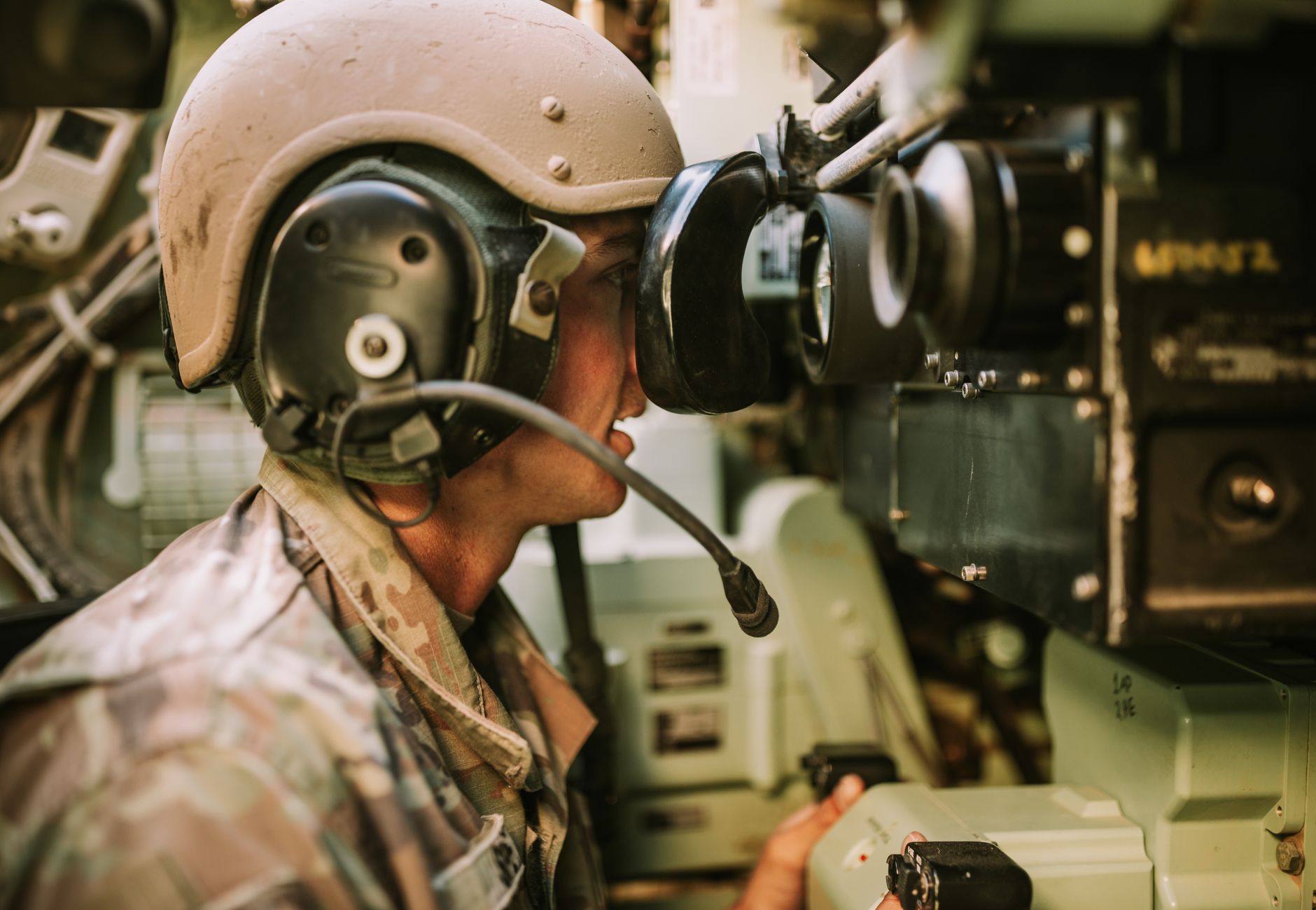 Photo by Art Guzman on Pexels.
That's not a knock on the tank crew. They're working with what they've got. The issue sits squarely with a procurement cycle that keeps layering new electronics onto an aging hull without ever stepping back to ask whether the whole sensor suite needs a rethink.
What the M1E3 Is Supposed to Do
The Army's announced intent for the M1E3 program is ambitious. Rather than another incremental SEP variant, the service wants a clean-sheet redesign addressing crew survivability, weight reduction (the SEPv3 topped out at 73 tons, which is a problem when most European bridges cap at 60), and a full next-generation sensor package. The sensor piece is where the night-vision problem should get solved.
Currently, Abrams crews rely on the Commander's Independent Thermal Viewer (CITV) and the Gunner's Primary Sight (GPS, confusingly named). Both use second-generation FLIR technology. Second-gen FLIR works well under ideal conditions. Smoke, dust, and humidity degrade it significantly. Ukraine demonstrated this clearly: thermal optics across multiple NATO-standard platforms struggled to discriminate targets through the persistent smoke and debris haze of urban combat. Crews reported situations where they could detect heat signatures but couldn't positively identify whether they were looking at a tank, a burning truck, or a building.
The M1E3 is supposed to swap in third-generation FLIR with AI-assisted target recognition. On paper, that closes the gap. In practice, the program is already running into the same headwind that derailed the IVAS headset and the XM30 infantry vehicle: integrating software-heavy systems into a hardware procurement process designed for bolts and armor plate.
The Weight Problem Makes Everything Worse
Here's the compounding issue. Every sensor upgrade adds weight. Weight management on a tank that's already too heavy for half the terrain it's supposed to operate on means every new capability requires trading something else out. The Army's solution for SEPv3 was to upgrade the tracks and suspension. That bought a few tons of margin. It didn't solve the underlying problem, and bridge load ratings don't negotiate.
For the M1E3, the Army is exploring composite armor to shed weight while maintaining protection. Composite armor is expensive and slower to manufacture than rolled homogeneous steel. So the timeline stretches, the cost grows, and the sensor suite gets pushed to a later block upgrade because the hull has to come first.
This is the procurement loop that keeps the Abrams perpetually almost modernized:
graph TD
    A[Identify Capability Gap] --> B(Fund Upgrade Program)
    B --> C{Weight / Cost Tradeoff}
    C --> D[Defer Sensor Package]
    D --> E[New Capability Gap Identified]
    E --> A
Every pass around that loop costs money and time. The SEPv3 entered low-rate initial production in 2017. Full-rate production didn't start until 2020. By the time those vehicles reach brigades, the threat environment has moved again.
What Ukraine Actually Taught Us
The harder lesson from watching armored warfare in Ukraine isn't about third-gen FLIR. Drone-dropped munitions and loitering munitions are killing tanks that the crews never saw coming from above. No thermal sight, however good, covers the upper hemisphere. The Abrams SEPv3 added the Trophy active protection system, which handles incoming missiles and RPGs reasonably well. It doesn't handle a $400 FPV drone diving from 60 degrees above the turret.
Some Army modernization advocates are pushing for an integrated 360-degree sensor fusion system that combines thermal, radar, and optical channels and feeds them through an AI threat-classification layer. That's the right answer. It's also a software and integration challenge that the Army's existing acquisition offices aren't structured to deliver quickly. Programs of Record move at Program of Record speed.
So the Abrams sits in a familiar place. Formidable on the terms it was designed for. Increasingly exposed on the terms of the current battlefield. Another upgrade program in the pipeline, with another expected delivery date that will slip, and another sensor package that will be state-of-the-art by the time it reaches the fleet, just not state-of-the-art for that year.
Forty-five years is a long run for any weapons platform. Whether the M1E3 genuinely reinvents the tank or just adds another layer to the same hull is the question the Army needs to answer before it signs the next contract. History suggests the answer will cost more than the estimate and arrive later than promised. The tank will still be impressive. It just might not be able to see you waving at it through the smoke.
Get Defense & Donuts in your inbox
New posts delivered directly. No spam.
No spam. Unsubscribe anytime.