Why the Air Force's $46 Billion Nuclear Bomber Program Can't Agree on How Many Bombers It Actually Needs
 K. Brennan
The B-21 Raider actually flies. That alone puts it ahead of several programs on this site, and credit where it's due: Northrop Grumman delivered a flying stealth bomber on a relatively compressed timeline by Pentagon standards. It looks like the future. It probably costs more than your city's entire annual budget per copy.
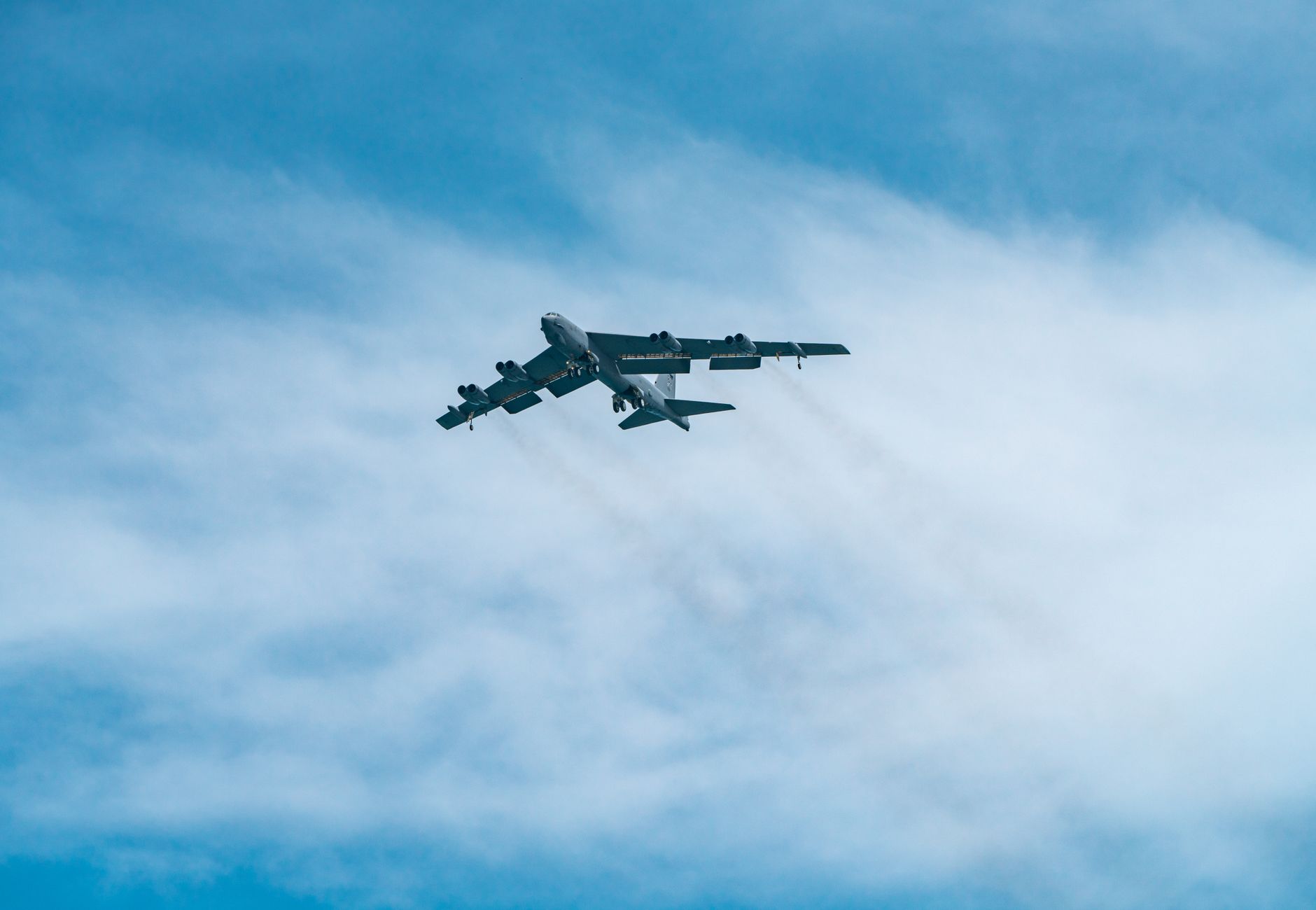 Photo by Alejandro Henriquez on Pexels.
So why, after spending roughly $46 billion in development and early procurement, does the Air Force still not know how many it needs?
This is not a rhetorical question. The official requirement has shifted so many times since the program was born out of the Long Range Strike Bomber competition that analysts tracking it have essentially given up using a single number. The current baseline sits around 100 aircraft as the minimum buy. The Air Force's stated desire, floated repeatedly in testimony and white papers, is closer to 220. The Congressional Budget Office has looked at both figures and politely noted that the actual funding trajectory supports neither.
Here's the core of the problem. The B-21 was designed as the backbone of America's nuclear triad delivery capability, meant to replace aging B-1s and B-2s while also handling conventional precision strike missions against hardened, defended targets. That's a dual mission with real merit. A penetrating stealth bomber that can carry both conventional and nuclear weapons gives combatant commanders genuine flexibility.
But flexibility costs money. Each B-21 carries an estimated unit price somewhere between $550 million and $700 million depending on which budget document you read and which year you're reading it in. Production efficiencies could theoretically bring that down as the line matures. Theoretically. The same promise was made about the F-35, and we're all familiar with how that math worked out.
graph TD
    A[B-21 Program Start] --> B(Initial Requirement: 100 Aircraft)
    B --> C{Force Structure Reviews}
    C --> D[Air Force Desire: 220 Aircraft]
    C --> E[CBO Funding Projection: Neither]
    D --> F(Budget Reality)
    E --> F
    F --> G[Actual Procurement: TBD]
The quantity debate matters for reasons beyond simple arithmetic. Nuclear deterrence is fundamentally a numbers game at some level. The 2022 Nuclear Posture Review acknowledged that China's nuclear buildup was changing the deterrence calculus, potentially requiring the U.S. to cover two near-peer adversaries simultaneously for the first time since the Cold War. If you're planning for that scenario, 100 bombers looks thin. If you're planning for budget realities, 220 looks like a fever dream.
There's also the survivability question baked into the quantity argument. The entire value proposition of a penetrating stealth bomber is that it can get through advanced air defenses. But stealth is not invisibility, and adversary air defense networks in 2026 are not what they were in 2008. Chinese and Russian investment in low-observable detection systems, including passive radar and long-wavelength early warning arrays, has been sustained and serious. The classified threat assessments presumably address this. The public record suggests the Air Force is aware that stealth margins erode over time and that quantity provides a hedge against attrition.
Then there's the sustainment problem that nobody wants to talk about at press conferences. The B-2 Spirit, which the B-21 is partly replacing, costs somewhere around $135,000 per flight hour to operate. The Air Force has projected B-21 operating costs will be significantly lower. Those projections were made before the program had substantial operational data, which is a polite way of saying they were optimistic estimates built to support a business case.
The B-1B Lancer fleet, slated for retirement as B-21s come online, currently handles a huge share of conventional long-range strike capacity. Retire them too fast and you have a coverage gap. Retire them too slow and you're paying to operate two bomber fleets simultaneously, which eats the procurement budget that would buy more B-21s. Pick your poison.
None of this means the B-21 is a bad airplane. By most credible accounts it's genuinely impressive, incorporating lessons from decades of stealth development in ways the B-2 couldn't anticipate. The program has avoided some of the most spectacular cost and schedule failures seen elsewhere in this era of defense acquisition.
What it hasn't avoided is the fundamental American defense procurement habit of designing a world-class system and then arguing indefinitely about how many you can actually afford. The airplane works. The strategy is coherent on paper. The budget is where things get complicated, and in that sense the B-21 program is running exactly on schedule.
Get Defense & Donuts in your inbox
New posts delivered directly. No spam.
No spam. Unsubscribe anytime.