Why the Navy's $5 Billion Zumwalt Destroyer Can't Afford to Fire Its Own Gun
 K. Brennan
The USS Zumwalt is one of the most visually striking warships ever built. Its tumblehome hull slopes inward like a stealth bomber's skin, its superstructure looks like something a production designer sketched for a sci-fi film, and it carries enough computing power to run a small city. It also has two enormous 155mm Advanced Gun Systems bolted to its deck that the Navy officially cannot afford to shoot.
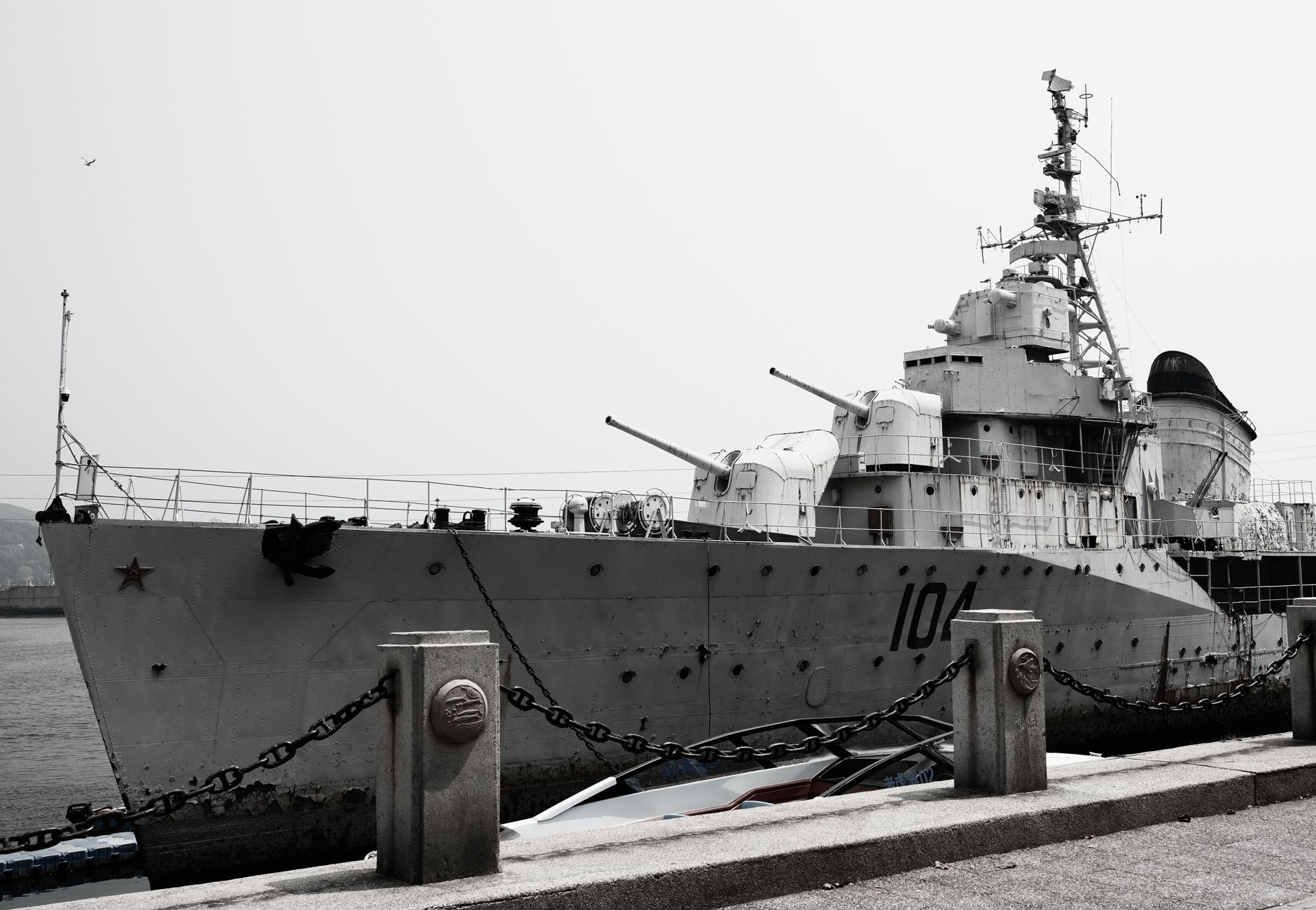 Photo by
 This is not a metaphor. The guns work. The ship works. The problem is the ammunition.
When the Navy designed the Zumwalt class in the early 2000s, the pitch was simple: replace the aging Iowa-class battleships' naval gunfire support role with a stealthy, modern destroyer. Soldiers and Marines on the beach needed fire support from offshore. The Advanced Gun System would deliver GPS-guided rounds called Long Range Land Attack Projectiles (LRLAP) out to 63 nautical miles. Impressive range, precision delivery, problem solved.
The math only worked with scale. Lockheed Martin priced the LRLAP rounds at roughly $50,000 each when the Navy planned to buy 32 Zumwalt-class ships. Then the Navy cut the order to 24 ships. Then to seven. Then to three. Each time the order shrank, the per-unit cost climbed. By the time the program stabilized at three hulls, each LRLAP round had ballooned to somewhere between $800,000 and $1 million depending on which budget document you believe.
For context: a Tomahawk cruise missile costs about $2 million and can travel 1,000 miles to hit a specific window in a specific building. Paying half a Tomahawk's price for a single artillery shell that goes 63 miles was not a trade the Navy was willing to make. In 2016, the service canceled LRLAP procurement entirely.
So the Zumwalt now sails with two very large, very expensive paperweights on its bow.
What followed was a years-long search for a replacement round that could fit the Advanced Gun System's 155mm barrel. The Navy looked at conventional artillery ammunition, modified existing rounds, and studied whether any off-the-shelf projectile could be adapted. None of them matched the system's required performance. The AGS was designed around LRLAP's specific dimensions and propellant charges. Retrofitting it for generic munitions would require modifications that kept getting quoted back at figures that made the original problem look cheap.
By 2022, the Navy gave up on the guns entirely. All three Zumwalts are being converted to carry hypersonic missiles under the Conventional Prompt Strike program. The Advanced Gun Systems are being removed. Physically cut off the ships and scrapped.
This is the part worth sitting with for a moment. The Navy built three ships specifically around a gun capability, spent over $5 billion per hull (the lead ship, USS Zumwalt, came in at roughly $4.4 billion; subsequent hulls ran higher with development costs factored in), watched the entire rationale for those ships become unaffordable, and is now paying to remove the guns and convert the vessels to a different mission. The hulls themselves are genuinely capable platforms. The stealth features, the Integrated Power System, the computing infrastructure: all of it has real value. Repurposing them for hypersonics is not an irrational decision.
But the original gun mission? Gone. Three billion-dollar ships were designed from the keel up for a capability that lasted approximately zero operational deployments.
The acquisition lesson here is painfully familiar. When a program's unit economics depend entirely on volume, and that volume gets cut, the program breaks. This happens constantly in defense procurement: the F-22 was supposed to cost $149 million per plane at 750 aircraft, ended up at $334 million per plane at 187 aircraft. The LRLAP story is the same dynamic compressed into a single line item.
Smaller orders mean higher unit costs. Higher unit costs trigger cancellations. Cancellations leave you with a $5 billion destroyer that can't shoot its own gun.
graph TD
    A[Navy plans 32 Zumwalt ships] --> B[LRLAP priced at ~$50K per round]
    B --> C[Order cut to 3 ships]
    C --> D[LRLAP price hits ~$1M per round]
    D --> E{Affordable?}
    E -->|No| F[LRLAP canceled 2016]
    F --> G[Search for replacement round]
    G --> H[No viable alternative found]
    H --> I[Guns removed, ships converted to hypersonics]
The Zumwalt class will likely have a second life as a hypersonic missile truck. The Conventional Prompt Strike weapon, which can reportedly reach ranges over 1,700 miles at Mach 5-plus, fits the ship's power generation capacity better than most other platforms in the fleet. There is a genuine argument that this is a better use of these hulls than shore bombardment ever was.
Still. Next time you see a photo of a Zumwalt looking sleek and futuristic on the open ocean, know that two of its most prominent features are hollow shells waiting to be scrapped. The Navy built the most advanced destroyer in the world, forgot to make the bullets affordable, and is now doing a very expensive renovation to pretend that was the plan all along.
Get Defense & Donuts in your inbox
New posts delivered directly. No spam.
No spam. Unsubscribe anytime.