Why the Air Force's $50 Billion KC-46 Tanker Can't Figure Out How to Look at What It's Refueling
 K. Brennan
Aerial refueling is one of those things that sounds deceptively simple. One plane flies behind another plane. A boom extends. Fuel transfers. Everyone goes home happy, or at least to the next target. The United States Air Force built a whole new tanker to do exactly this, spent north of $50 billion on it, and the resulting aircraft, the KC-46 Pegasus, cannot reliably watch its own boom connect to another airplane.
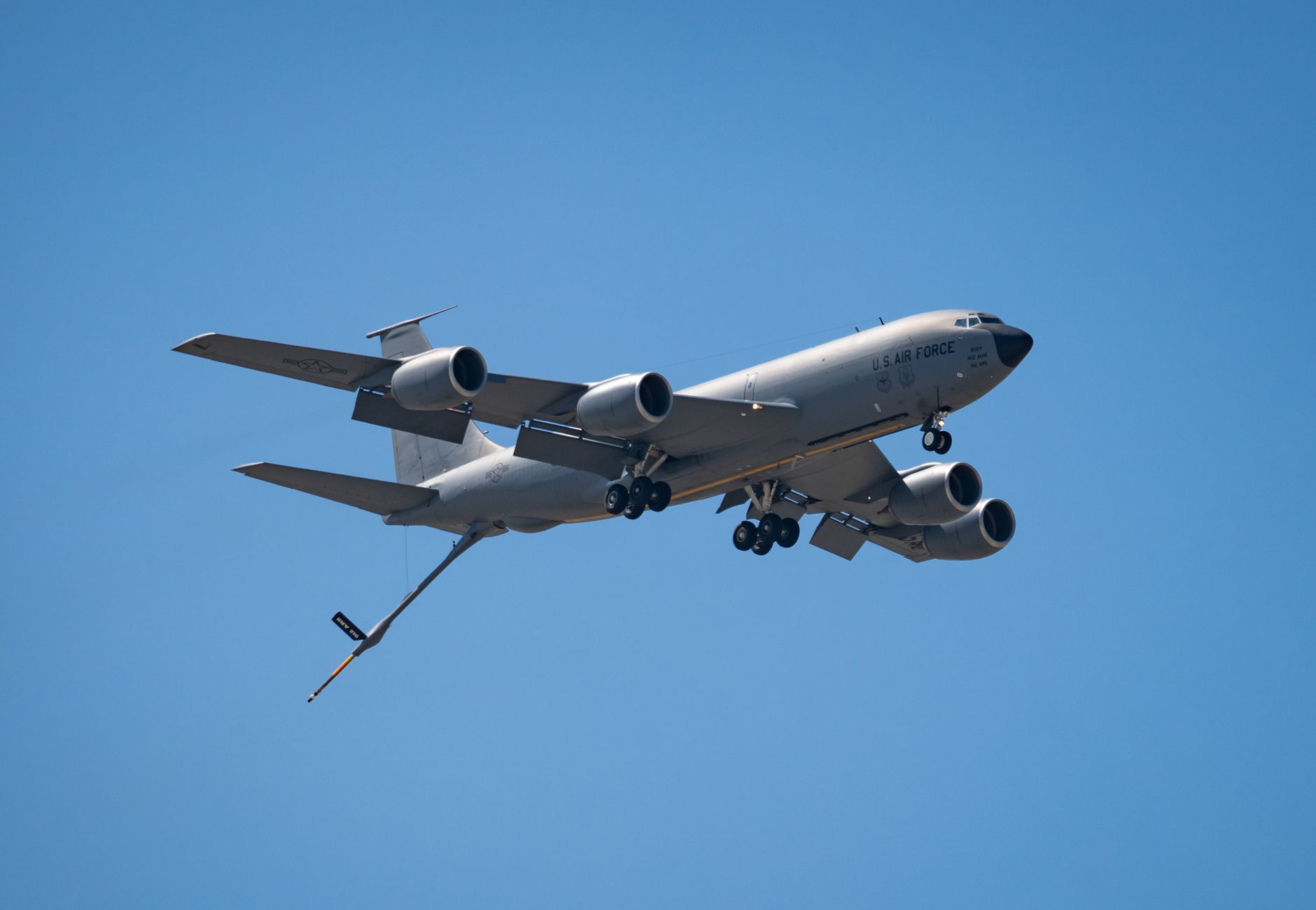 Photo by Soly Moses on Pexels.
That sentence deserves a moment to sit.
The KC-46 replaced the aging KC-135 Stratotanker, which has been flying since 1956. Boeing won the contract in 2011, based heavily on a modified 767 commercial airframe. The pitch was smart: use existing technology, reduce risk, keep costs down. By 2023, the program had ballooned past $50 billion in total lifecycle costs and accumulated over $7 billion in cost overruns that Boeing was on the hook for. For a program sold partly on fiscal responsibility, that stings.
But the overruns aren't even the most embarrassing part.
The KC-46's central flaw lives in a system called the Remote Vision System, or RVS. Unlike the KC-135, where a boom operator lies prone in the tail and watches the refueling connection with their own eyes, the KC-46 operator sits in a forward crew station and watches through cameras. The cameras, in theory, provide better situational awareness, more ergonomic working conditions, and modern sensor integration.
In practice, the RVS produced images with poor depth perception, distorted spatial cues, and low resolution in certain lighting conditions. Boom operators couldn't reliably judge the distance between the boom and the receiver aircraft's refueling receptacle. The Air Force declared this a Category 1 deficiency, which is the military's polite way of saying "this could kill someone or mission-fail in combat." They accepted delivery of the aircraft anyway, on the theory that Boeing would fix it.
Boeing's fix was RVS 2.0. It took years. The Air Force certified RVS 2.0 in late 2023, and the upgraded system genuinely improved things. Depth perception got better. Image fidelity improved. But the KC-46 still carries restrictions on which aircraft it can refuel. The A-10, the C-17, certain receiver configurations, the list of aircraft the KC-46 cannot safely refuel in all conditions remains longer than anyone is comfortable admitting publicly.
Here's what the restrictions mean operationally. A tanker that can't refuel certain aircraft in a contested environment is a tanker with conditional utility. The whole point of a tanker is to extend range and persistence for combat aircraft. If the tanker has to turn away a thirsty A-10 because the boom operator can't see clearly enough to make the connection safely, that aircraft either aborts its mission or finds a KC-135. There aren't many KC-135s left, and they're old enough to have grandchildren.
graph TD
    A[KC-46 Deployed] --> B{RVS Camera Quality?}
    B -->|Clear conditions, compatible receiver| C(Refueling Proceeds)
    B -->|Poor lighting or restricted receiver type| D{Find a KC-135?}
    D -->|KC-135 available| E(Refueling Proceeds)
    D -->|No KC-135 available| F[Mission Aborted or Range-Limited]
The deeper issue is how the program got here. The Air Force accepted a developmental aircraft with a known Category 1 deficiency because the schedule pressure to field a new tanker was real. The KC-135 fleet is aging badly. Accepting a flawed KC-46 was, from a certain angle, rational: get the aircraft in the fleet, get crews trained, fix the vision system in parallel. The problem is that "fix it in parallel" requires Boeing to actually fix it, and Boeing's incentive structure on a fixed-price contract with cost overruns already eating their margins was not exactly oriented toward aggressive spending on remediation.
This is a pattern worth recognizing. The KC-46 didn't fail because someone made a catastrophically bad decision. It accumulated problems across a decade of schedule pressure, contractor optimism, and an acceptance philosophy that prioritized delivery dates over capability thresholds. Each individual decision was defensible. The aggregate result is a $50 billion tanker with a vision restriction waiver list.
For context: the Air Force needs roughly 479 tankers to meet its wartime requirements. The KC-46 is supposed to fill that gap. Right now, the fleet is operational but constrained, and the KC-135s it was meant to replace are still flying missions the KC-46 can't cover.
The good news, if you're looking for it, is that RVS 2.0 is a real improvement and the remaining restrictions are narrowing. Boeing has paid for its mistakes financially, even if the Air Force paid operationally. The KC-46 will eventually be the capable tanker it was designed to be.
It just needed a decade and $7 billion in overruns to learn how to watch what it's doing.
Get Defense & Donuts in your inbox
New posts delivered directly. No spam.
No spam. Unsubscribe anytime.